Grupo Cine Liberación
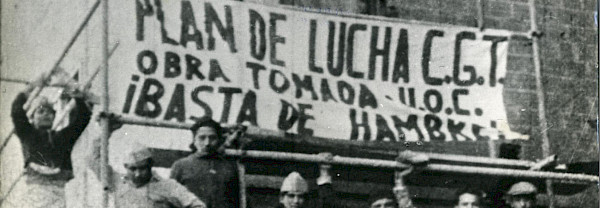 "La hora de los hornos" frame
Biography
Solanas and Getino were also the authors of the manifesto Hacia un tercer cine: apuntes y experiencias para el desarrollo de un cine de liberación en el Tercer Mundo, committed to producing a cinema of resistance against imperialism. The text was first published in the Cuban magazine Tricontinental, vol. 13, p. 120, October 1969. Later, in 1971, they published the manifesto Cine militante: una categoría interna del Tercer Cine, with the intention of reinforcing the role of cinema as a militant tool aligned with Peronism.
The film La hora de los hornos marks the starting point of the first phase of the Grupo Cine Liberación, and the return of Peronism to government in 1973 signals the beginning of a second phase, which ended with the 1976 coup and the exile of some group members.
Alongside “Pino” Solanas and Octavio Getino, the group also included Gerardo Vallejo and María Elena Massolo, Octavio Getino’s wife. Other Argentine film movements of the time, such as the Grupo Cine de la Base and the Realizadores de Mayo, orbited around Cine Liberación, establishing frequent collaborations with Enrique and Nemesio Juárez, among others.
For the group, cinema was both a means of resistance against the dictatorship and a liberating political process aimed at the working class as the agent of revolutionary transformation in Argentina. In this sense, the manifesto Hacia un Tercer Cine stands as a declaration of intent regarding the content and form of revolutionary cinema in opposition to a hegemonic cinema that only transmitted what the system allowed (Solanas). For this reason, they opposed what they called First Cinema, which they associated with the Hollywood film industry—defined as bourgeois cinema, alienating entertainment cinema aligned with the interests of imperialism and neocolonialism. They also rejected Second Cinema, which included “auteur cinema,” “expression cinema,” the nouvelle vague, and cinema novo, considering it reformist and insufficiently transformative.
On the other hand, influenced by the Algerian war of liberation and Guevarism through thinkers like Frantz Fanon and Che Guevara, Cine Liberación located Third Cinema within the anti-imperialist struggle of the peoples of the Third World, understood as «the most gigantic cultural, scientific, and artistic manifestation of our time, the great possibility of constructing from each people a liberated identity, the decolonization of culture».*
Despite being banned from public screening in Argentina until 1973, La hora de los hornos and the manifestos of Cine Liberación gained significant international visibility between 1968 and 1978, coinciding with the rise of political and militant cinema across the world.
*The film can be viewed on this website.
Methodology
Cine Liberación opened an alternative circuit by forming Mobile Units of Cine Liberación or dissemination groups, with the goal of clandestinely screening their films as material for collective discussion. For the group, each screening was a catalytic “act” of awareness and political action. When La hora de los hornos began, the screen displayed a quote by Frantz Fanon: “Every spectator is either a coward or a traitor”, thus aiming to transform the role of the viewer into that of a militant activist “called upon to modify and ‘complete’ the film—in other words, to make it, to construct it”. The film included pauses and interruptions to invite constructive debate with the audience, who identified with the social struggles shown on screen. “What matters is not the film image, but the living act that opens in each screening. The possibility of deep communication between the comrades who are protagonists in the struggle for liberation; those who are on screen and in the room at the same time”, said its authors.
The experience sought by Third Cinema was not, then, to film workers inside the factory or as they left it, but to provoke them to become aware of their own representation as agents of change.
Filmography
La hora de los hornos (1968), 4-hour documentary directed by Fernando Solanas and Octavio Getino.
La Paz (1968), short film of counter-information and political agitation directed by María Elena Massolo.
Cineinformes de la CGT (1968–1969), cinematic newsreels.
Ya es tiempo de violencia (1969), anonymous, produced by Enrique Juárez.
El camino hacia la muerte del Viejo Reales (1971), directed by Gerardo Vallejo.
Perón: La Revolución Justicialista (1971), feature-length documentary.
Perón: Actualización política (1971), feature-length documentary.
Doctrinaria para la toma del poder (1971), feature-length documentary.